GIADA GANASSIN
PAINTING
2023 - ungoing

Jour de pluie 2026
80x110 cm
oil and acrylic on canvas

Deux horizontal 2026
80x100 cm
oil and acrylic on linen

Les hautes herbes 2026
16x23 cm
oil on canvas

Fourmi 2026
38x28 cm
oil and acrylic on canvas

Festina lente 2026
19x12 cm
oil on canvas

Mimosa 2026
38x28 cm
oil and acrylic on canvas

Cerise 2026
51x33 cm
oil and acrylic on canvas

Le rêve d’Ulysse 2026
35x27 cm
oil and acrylic on canvas
 Dernier métro 2025
81x100 cm
oil and acrylic on canvas
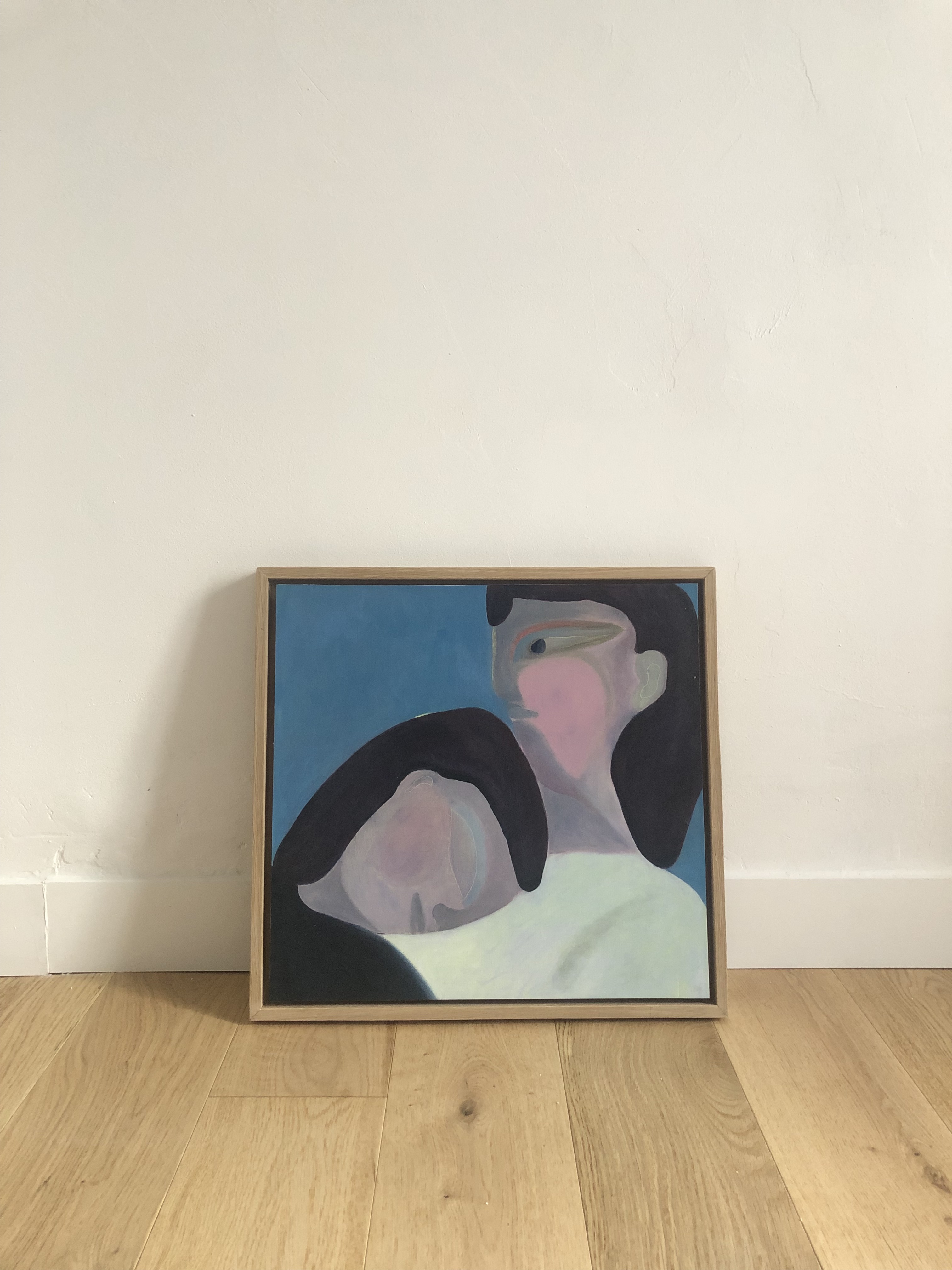
L’onda 2024
35x35 cm
oil and acrylic on canvas paper
The bodies the artist paints on her canvases are spaces in their own right. They possess a statuesque presence and an imposing gentleness. Forms with rounded contours, exist with a quiet power.
In the smaller works — a format characteristic of the artist’s early paintings — lunar faces take center stage, sometimes spilling beyond the edges of the frame. Bodies rooted like the Piedmontese mountains at the foot of which the artist grew up, and which, like those mountains, can be both an obstacle and a refuge for everyone. While the subjects of the drawings on paper are reduced to the clean lines of their outlines, the artist’s canvases become more ethereal, with undulating and sometimes slightly blurred contours. The body of work resonates as a unified whole, with a consistent treatment of both the foreground and background in the canvases. The shape of a face echoes the mountain in the background of the work *Mimosa* (2026). The curve of a finger follows the stem of a fruit in *Cerise* (2026), while the close-up faces in the works *Les hautes herbes* (2026) and *Fourmi* (2026) seem to emerge from the blades of grass upon which they rest.
Ganassin goes through several stages to create her paintings, though she does not follow a specific protocol. A sketch may sometimes precede the canvas — such as a photograph taken on the spot on the street or on public transportation.
Municipal painting classes have taught her certain techniques and refined the way she likes to work. The artist paints as she draws, with quick, spontaneous strokes, seeking to capture the moment. Linseed oil, which dries slowly, allows her to shape her composition and to go back over or add elements once her first version is complete. Beneath the very thin layers of oil paint, accents of fluorescent acrylic catch the light and illuminate the space of the canvas from within.
The interior — the central subject of these paintings — draws us into their peaceful introspection. Ganassin’s figures have their eyes closed, which does not mean they are asleep. Depicted in open, outdoor settings — which we instinctively assume to be public spaces when viewing the paintings — they seem to exist in their own world, without, however, completely escaping our shared reality.
A window, a house, a mountain: there always seems to be both an exit and an entrance into this inner world with its softened contours. In the most recent paintings, the settings become more precise, the figures more numerous. Silhouettes in *Rainy Day* are pressed against one another on a bus, temporarily inhabiting this shared, shifting, and transient space. Two female figures in *Dernier métro*, tenderly connected, their minds or bodies weary, with their backs to a staircase leading toward whatever each viewer chooses to imagine.
Anna Priot-Daran
︎︎︎ Bureau Idéal